Explore a subject through time
Natural World timeline
Life, evolution, extinctions and the changing planet.
39 moments in QuoAnno
Reading the timeline
A wider chronology
Natural history stretches far beyond written records. It follows the formation of Earth and the Moon, the earliest evidence of life, the evolution of complex organisms, mass extinctions and the emergence of species familiar today. The scale is measured in millions and billions of years as well as centuries.
Deep-time dates are reconstructed from rocks, fossils, radiometric dating and comparisons between many lines of evidence. They are often ranges rather than exact points. QuoAnno presents those estimates honestly and uses the timeline to show how brief recorded human history is beside the history of life and the planet.
What this category covers
Themes to follow
Planetary beginnings
The formation and early transformation of Earth, its atmosphere and its oceans.
Evolution of life
Major transitions from early organisms to plants, animals and human ancestors.
Extinction and recovery
Biological crises that removed dominant groups and opened new ecological possibilities.
Evidence and uncertainty
How fossils, geology and dating methods support ranges rather than false precision.
Across the category
Timeline highlights
Earth forms
Radiometric dating places Earth’s age at about 4.54 billion years.
The Sturtian Snowball Earth glaciation begins
The Sturtian glaciation, also known as the Sturt glaciation, was a worldwide glaciation during the Cryogenian Period when the Earth experienced repeated large-scale glaciations.
The Late Ordovician mass extinction occurs
The Late Ordovician mass extinction, sometimes referred to as the end-Ordovician mass extinction or the Ordovician–Silurian extinction, is the first of the "big five" major mass extinction events in Earth's history, occurring roughly 445 million years ago.
Vast Carboniferous coal forests spread
Coal forests or coal swamps were the vast swathes of freshwater swamp and riparian forests that covered much of the lands on Earth's tropical regions during the late Carboniferous and Permian periods.
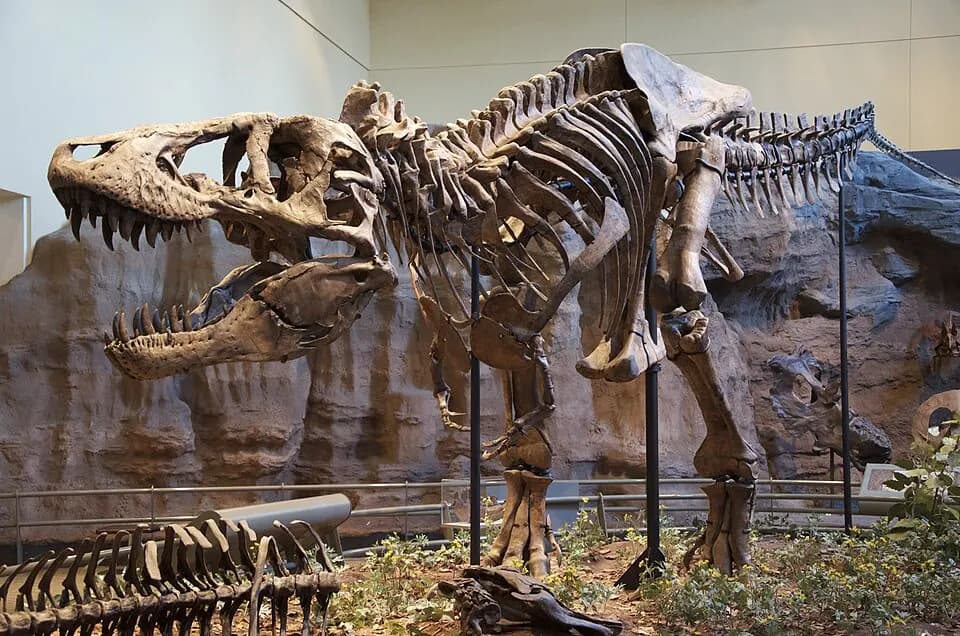
Tyrannosaurus rex appears
T. rex lived very near the end of the non-avian dinosaur era.
Non-avian dinosaurs go extinct
Birds are living dinosaurs and survived the extinction.
Homo sapiens appears
Fossils from Jebel Irhoud in Morocco pushed the known history of Homo sapiens back to roughly 300,000 years.
Last widely accepted sighting of a living dodo
1662 is commonly cited for the last accepted sighting, though later reports are debated.
Continue researching
Further reading
These independent reference works and institutions provide broader context. QuoAnno links to them for further reading; the summaries on this page are original and are not copied from those sources.
Test your chronology
