Explore a subject through time
Science timeline
Discoveries and experiments that changed how we understand reality.
39 moments in QuoAnno
Reading the timeline
A wider chronology
The history of science is not a straight march from ignorance to certainty. It is a record of observations, instruments, arguments, failed explanations and results that other researchers could test. Discoveries become historical landmarks when they change what questions can be asked or how evidence is interpreted.
A chronological view also reveals that scientific work is collective. Famous publications and experiments depend on earlier methods, shared institutions and contributions that may be recognized only later. QuoAnno places those milestones alongside the wider worlds of medicine, technology and exploration.
What this category covers
Themes to follow
Observation
Telescopes, microscopes and measurements that made previously hidden phenomena visible.
Experiment
Repeatable tests that challenged explanations and established new evidence.
Theory
Models that connected separate observations into broader accounts of nature.
Scientific communities
Publication, correspondence, laboratories and institutions through which knowledge was tested.
Across the category
Timeline highlights
Copernicus publishes De revolutionibus
The book was published near the end of Copernicus’s life.
Leeuwenhoek observes microorganisms
Antonie Philips van Leeuwenhoek was a Dutch microbiologist and microscopist in the Golden Age of Dutch art, science and technology.
Faraday discovers electromagnetic induction
In electromagnetism, Faraday's law of induction describes how a changing magnetic field can induce an electric current in a circuit.
Mendeleev presents an early periodic table
Mendeleev left gaps for elements that had not yet been discovered.
Max Planck introduces the quantum hypothesis
In physics, Planck's law describes the spectral density of electromagnetic radiation emitted by a black body in thermal equilibrium at a given temperature T, when there is no net flow of matter or energy between the body and its environment.
Alexander Fleming observes penicillin’s antibacterial effect
Turning penicillin into a widely usable medicine required later work by several researchers and teams.
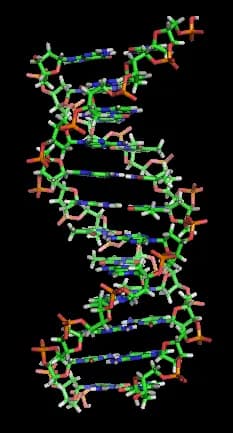
Double-helix structure of DNA is published
Rosalind Franklin’s X-ray diffraction work was crucial to understanding DNA structure.
Plate tectonics becomes a unified scientific theory
Plate tectonics is the scientific theory that Earth's lithosphere comprises a number of large tectonic plates, which have been slowly moving since 3–4 billion years ago.
Continue researching
Further reading
These independent reference works and institutions provide broader context. QuoAnno links to them for further reading; the summaries on this page are original and are not copied from those sources.
Test your chronology
