Explore a subject through time
Ancient & Medieval timeline
Empires, rulers, battles and turning points before the modern age.
39 moments in QuoAnno
Reading the timeline
A wider chronology
Ancient and medieval history connects the first large states and written records with the many societies that shaped Africa, Asia, Europe and the Americas before the modern era. A timeline helps place long-lived empires, religious change, trade networks, migrations and political upheavals beside one another without reducing the period to a list of rulers and battles.
The dates below range from early monuments and classical civilizations to late-medieval institutions. Some are securely tied to a year; others depend on later chronicles, archaeology or conventional dating. QuoAnno keeps those distinctions visible while using BC and AD throughout its player-facing chronology.
What this category covers
Themes to follow
States and empires
The rise, administration and fragmentation of kingdoms, republics and imperial systems.
Belief and learning
Religious institutions, philosophy, scholarship and the transmission of texts and ideas.
Trade and movement
Routes, cities, migrations and exchanges that connected distant communities.
Conflict and succession
Wars, conquests and disputed transfers of power that redirected political history.
Across the category
Timeline highlights
The Great Pyramid of Giza is completed
Its construction date is estimated from archaeological and historical evidence rather than a single surviving completion record.
The Battle of Thermopylae is fought
The Battle of Thermopylae was fought in 480 BC at Thermopylae between the Achaemenid Persian Empire under Xerxes and an alliance of Greek city-states led by Sparta under Leonidas I.
Qin Shi Huang unifies China
230 - 221 BC) were a series of military campaigns launched in the late 3rd century BC by the state of Qin against the other six states remaining in China – Han, Zhao, Yan, Wei, Chu and Qi.
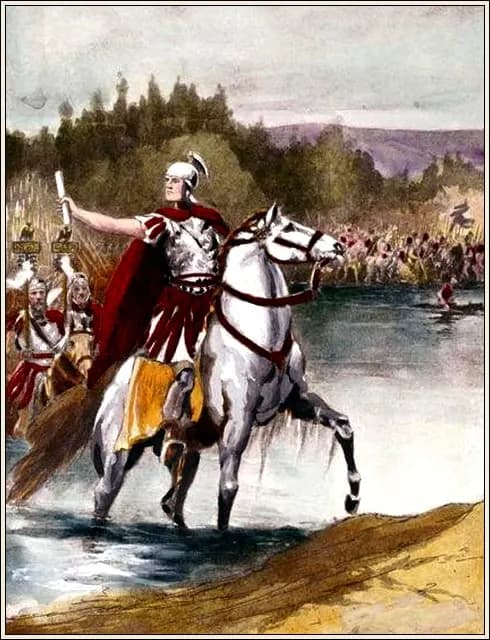
Julius Caesar crosses the Rubicon
“Crossing the Rubicon” became a phrase for passing a point of no return.
Julius Caesar is assassinated
Caesar was killed in the Theatre of Pompey in Rome.
Octavian wins the Battle of Actium
The Battle of Actium was a naval battle fought between Octavian's maritime fleet, led by Marcus Agrippa, and the combined fleets of Mark Antony and Cleopatra.
The First Council of Nicaea convenes
The First Council of Nicaea was a council of Christian bishops convened in the Bithynian city of Nicaea by the Roman Emperor Constantine I, also known as the First Ecumenical Council.
Muhammad completes the Hijra to Medina
The Hijrah, also Hegira, was the journey the Islamic prophet Muhammad and his followers took from Mecca to Medina.
Continue researching
Further reading
These independent reference works and institutions provide broader context. QuoAnno links to them for further reading; the summaries on this page are original and are not copied from those sources.
Test your chronology
